Features
Hawaiʻi Review 91
words poured across oceans: Black Indigenous Connected Resistance and Interventions in Blood.
Creative Nonfiction
Looking for something ‘real?’ The Creative Nonfiction features are the ones for you.
Hula is not a universal spiritual practice. It belongs to Hawaiian people and this ‘āina. Even beginning hula students know that hula recounts and honors the reciprocal and familial relations Kānaka Maoli share with this archipelago and its inhabitants–the plants, animals, ancestors, natural energies, and land. Hula practitioners know that Mauna Kea is a sacred dwelling place of akua, a beautifully unique ecosystem, and a living ancestor of Kānaka Maoli.
This month marks the 50th anniversary of the Stonewall Riots, a foundational moment for the LGBTQIA+ liberation movement. New York City’s multiracial LGBTQIA+ community rioted against police brutality in response to a late-night raid of the Stonewall Inn. Half a century later, it is important for us to remember the angry, political, and disruptive roots of the LGBTQIA+ movement. While trans and gender non-conforming (GNC) people of color have always been instrumental in the alliances that powered the Stonewall Riots and the many decades of activism since, these same members of our communities today are at much higher risk of violence than their white and cisgender contemporaries. As Black lesbian feminist Audre Lorde wrote, “I am not free while any woman is unfree, even when her shackles are very different from my own.” We, the LGBTQIA+ community, must resist oppression in all forms, including colonialism.
For queer settlers in Hawaiʻi, Pride is the time to practice the solidarity that was the founding principle of our movement. On October 30th, 2018, news broke that The Hawaiʻi State Supreme Court ruled in favor of continued construction of the Thirty Meter Telescope (TMT) on Mauna Kea, despite intense resistance and outcry by the Kanaka Maoli community and allies. Earlier that day, University of Hawaiʻi (UH) President David Lassner sent a system-wide email calling for a renewed “climate of aloha” at UH which centered on civility, tolerance, and kindness. This email was veiled as a response to the rapid spread of violent political rhetorics across the United States, and the deliberate erasure of trans and GNC identities by the Trump administration.
As queer settlers, we (the authors) were and continue to be furious that Lassner would co-opt the struggles faced by the trans community to veil the UH administration’s active silencing of Kanaka Maoli voices and erasure of Kanaka Maoli bodies. As those of us who are trans and GNC are well aware, the UH system isn’t a trans-safe environment. The system also repeatedly fails in its mission as a Native Hawaiian-serving institution, or even to serve as a safe space for Kanaka Maoli and other Indigenous peoples. It was hard to miss the hypocrisy of calling for a watered-down version of “aloha” while the UH administration violently pushed forward with the construction of the TMT. Lassner serves only the wallet of UH by co-opting and distorting aloha as a synonym for passive civility.
In the face of the fact that Haiti still lives, after being boycotted by all the Christian world; in the face of the fact of her known progress within the last twenty years; in the face of the fact that she has attached herself to the car of the world's civilization, I will not, I cannot believe that her star is to go out in darkness, but I will rather believe that whatever may happen of peace or war Haiti will remain in the firmament of nations, and, like the star of the north, will shine on and shine on forever.
Frederick Douglass, “Lecture on Haiti,” 1893
In 1804, from the city of Gonaïve, after a thirteen-year battle, African slaves of the French colony Saint-Domingue emancipated themselves, eliminated slavery from the island, and founded the Haitian republic. Haiti became the first black-led republic in the world, the only country ever to be born from a slave revolt, and the first independent country in Latin America. The Haitian Revolution and the American Revolution were the only two rebellions in the New World to achieve permanent independence. While the United States prospered from its continued enslavement of blacks and went on to become the richest country in the world, Haiti lost its title as the wealthiest and most prosperous of any country in the Caribbean when it “shackled” itself to France’s ankles through reparation to become the poorest country in the Western Hemisphere.
On January 1, 1804, from the city of Gonaïve, newly freed African slaves of the French colony Saint-Domingue founded the new nation of Haiti. Haiti was the first black-led republic in the world, the only country ever to be born from a slave revolt, and the first independent country in Latin America. Former slaves of the island modified the spelling of the original name, Ayiti, meaning “home or mother of the earth” in the Taino-Arawak Native American language, and “sacred earth or homeland” in the Fon African language, in order to symbolize a new era, and breakaway from the period of slavery. But Haiti agreed to make reparations to French slaveholders in the amount of 150 million francs in exchange for international recognition.
When the slaves were fighting for freedom and independence, it is safe to say that not one of them could have envisioned such an unexpected consequence resulting. But reparation became just that: an unanticipated consequence that indemnity bankrupted the newly-founded country. This unanticipated consequence of freedom took more than a century to pay, well into the 1950s, and bled away Haiti’s resources for economic development. The burden of such a heavy financial obligation left the people of Haiti, a country in financial balance, no chance of any sort of common financial future. It begs the question why? Why did the Haitians cave to the demands of France? They had just defeated one of the strongest, richest countries in the world. They had freed themselves from slavery, and established a new country. They had the skills and the equipment to produce some of the world’s most sought after commodities, commodities that had made France so rich and so powerful. So why?
He loved me when no one would
He brought me wild fruit in a wooden plate
He squeezed the teats of the mother cow
whilst I opened my mouth under its bulging udder
I’ve been listening to good voices
floating across prairie nights.
Tuning in and turning my heart
catching just a few words.
I’ve been lying beneath a star blanket
thinking about the stars I can’t see.
This is my yum
made by my
mother’s best friend
who was
murdered. In English
this yum is called
a string or net bag.
Orphan Lights
Two Fathers packed us shivering
into the rectory’s station wagon
where our stuttered breaths fogged
windows spider-webbed with frost.
I rubbed circles with my sleeve
to see the cemetery angel glisten
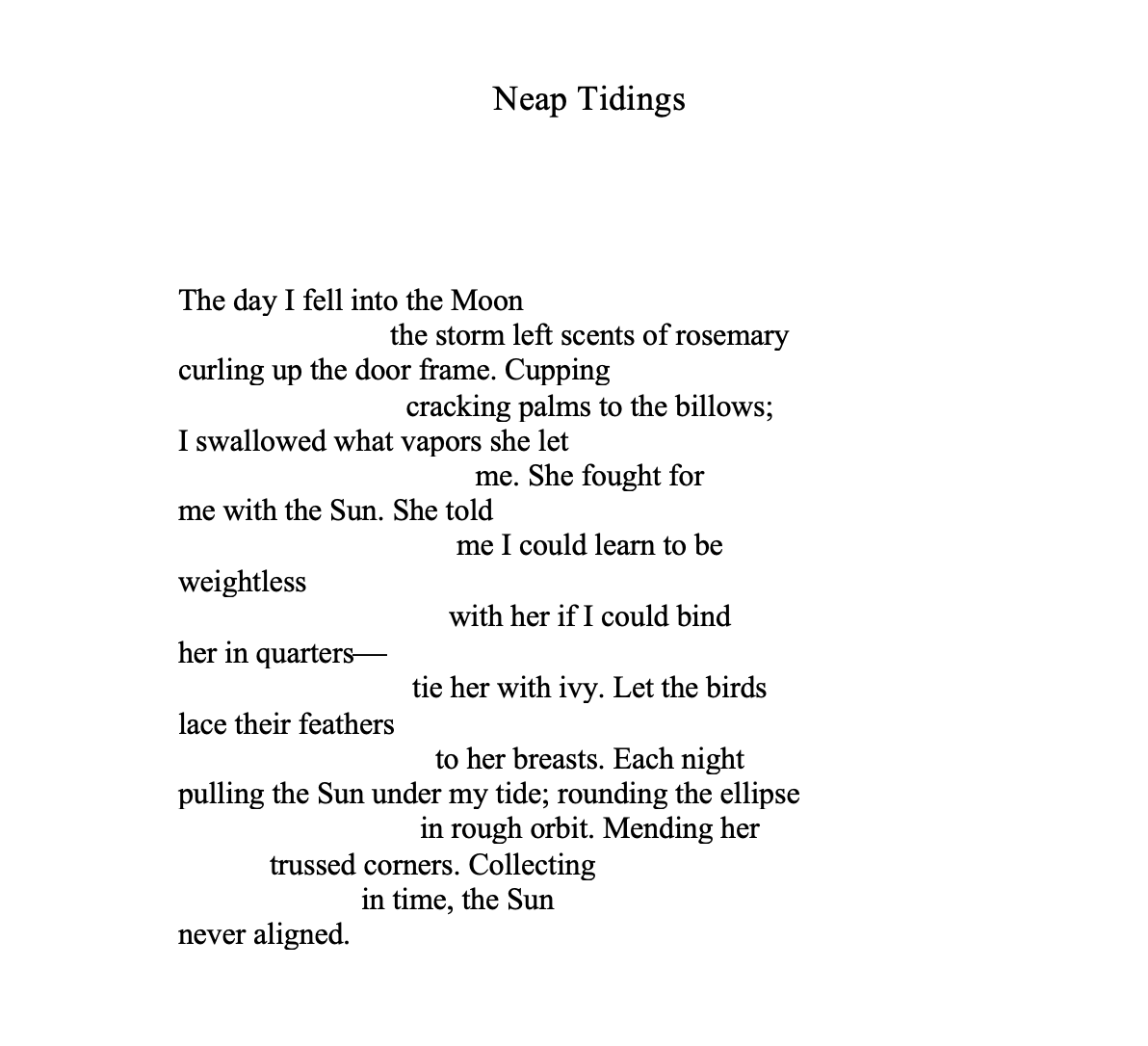
Neap Tidings
The day I fell into the Moon
the storm left scents of rosemary
curling up the door frame. Cupping
cracking palms to the billows;
I swallowed what vapors she let
me. She fought for
me with the Sun. She told
me I could learn to be
weightless
with her if I could bind
her in quarters –
tie her with ivy.
Leaning out of the open window to feel
the chill of night air breathing on your skin.
Your chest is heavy, & the stars are being buried
under cover of cloud as we speak. The distant sky
is humming with oncoming rain. How soon
this sky will break open with light, leaving you
breathless once again. Hold onto this feeling
as you remember the field of hibiscus flowers
at the edge of Tutu’s corner of this island.
Can you see them? & among them, can you see her?
Tutu, sitting in the company of these flowers,
her long greying hair floating down her back gently. Tutu,
dancing around the small green kitchen as she boiled taro root,
& when Kupuna came home from the sugar cane
fields do you remember how they would dance together?
Kupuna's hands resting smoothly on the small of her back,
Tutu’s face bright & shiny & laughing, always laughing.
& can you still hear her? Humming those old songs whose words
you used to know so well, as she moved about that old house,
falling apart; as she braided those blossoms of yellow & pink & orange
into your hair on special occasions & Tuesdays. She is waiting there
in the night sky for you, in between Orion’s belt & the Na-hiku.
Pectus excavatum
I found my self this morning, deep sea diving
near the seafloor: coral-conquered, shipwrecked,
covered in barnacles, sea cucumber oil, writhing
around the neck of the merman on the prow: a locket?
I took it into my whale-mouth, swam to the surface.
On shore, huge human again, I took it out, looked
inside: myself, kindergartenized, non-Adonis
in miniature. The locket hung on golden chain,
the clasp cold and tough on blubberbutt hands.
I washed it off with seawater, watched it line
my fingernails with rust. I put it on anyway. But then,
beach-combing, exposed by the weight of real men's eyes,
I tripped over the long chain—
how did it grow so long?—and watched the lifelines
the chain had traced in the sand dance like paper shriveling
in the fire. Mesmerized, I sat until the wind blew the sand soft,
then swam for horizon. For home. The chain, of course,
tugged to shore. And at that slightest resistance,
I ducked my whale-head free from the chain
and watched my small self sway. The sun fell.
I glinted once, a stuttering candle,
and
we
sunk.
___________________
Stephen Reaugh | grew up in western Pennsylvania, on the outskirts of the Allegheny National Forest. In 2016, he obtained an M.F.A. in Creative Writing from the University of Alabama. his creative work has appeared in Pomona Valley Review, Rabbit Catastrophe Review, and The Doctor T.J. Eckleburg Review. Currently, he is an M.A. student in English Literature at Villanova University.

Palmistry
You pressed your palm towards me,
a force of white air smacking my face
in an exasperated sigh
which dares to whisper a name I cannot seem to shed
even in my most desperate metamorphosis
The lines of your palm
read like a mass grave
red as the blood conjured by firing-squad sorcerers
the soft sloping of arches that mimic
mountain peaks filled with blue ghosts-
My lost Moravia.
there is a voice behind
each morning prayer that
wakes Jerusalem before the
rooster’s shrill cry -
and before
it was a boisterous thing,
it was small; tiny itch
nestled between vocal chords,
brief settler - barely a home
at all -
much like the heart
whose swelling cries & floods
& tears membranes with its
wanting & maybe wanting
is its own home -
You were the wrath of a rock with mouth opened.
With a face through which death has passed, you came back
with shoulders which changed the wind’s path.
I am all the sad women,
women who bring loneliness to bed.
Cold passes even the surface of the house;
Beneath the wallpaper it becomes jaundice . . .
When I see a cardinal in February, I think of snow
even as I stand on a green lawn beneath palms
and plumeria, watering the grass. I think the bird
I did not find the lost oasis
of Zarzura, nor spears and swords
of Persian armies drowned
in sand, not even the wreck
of Count Almasy’s plane,
dear baby with your hands in the air
tears in your eyes and explosions in your ears
Excuse me miss
Maybe it’s the dim lighting
but what is your ethnicity
or the aroma of spices
because you’re too beautiful
but a funny thing happens
to be Native American
"All cargo must filter through a beagle’s wet nose
though no hound found me in 29-E,
coiled behind a toddler’s homesick wail."
"Roaming across the Zumwalt Prairie,
I play my flute.
The Nez Perce know I am coming when
a tune in my key approaches."
"The summer heat wave hung, heavy on our bones,
and fat flies droned on the windowsills.
Our airedale hid, snapping at our fingers.
She would not leave the cold dark space beneath
our back door steps."
"the Fantastic Four is tré shitty but tough shit. Michael B. Jordan is already on flame. on fleek. he’s ahead of the game’s excited red, to the danger zone and beyond. so innanet trolls seem quite non-toxic,"
"my mouth is a room that lights up in the dark
the girl who trained me spatula-full of radium in her mouth the corners gritty
and glowing her reassurance that the paint is harmless taught us how to point the paintbrush tip between our lips"
"The pungent smell of fresh cut grass on a Saturday morning
My grandma frying up bundi bundi
The scalding oil searing my lips and tongue
Too anxious to wait for it to cool"